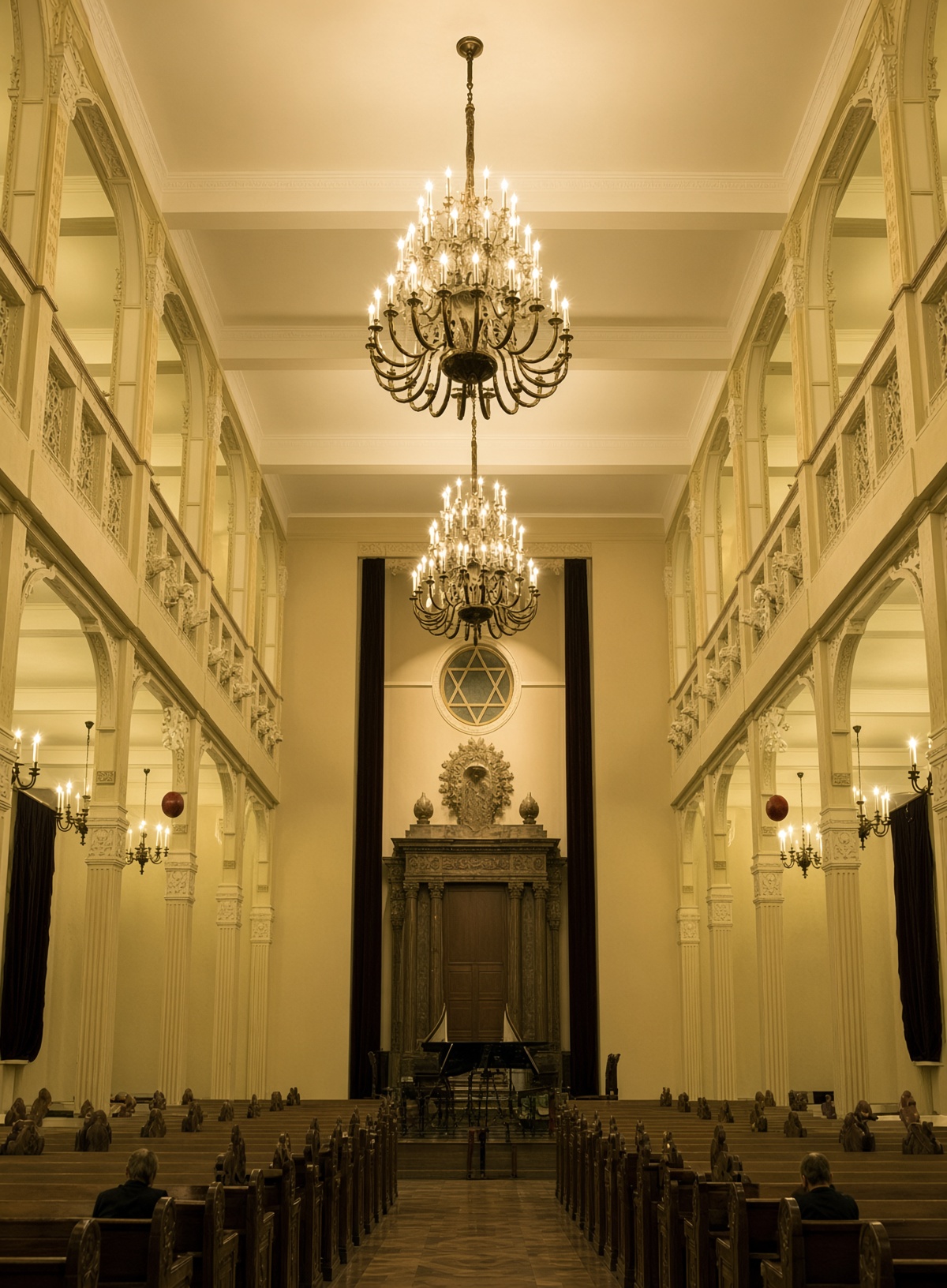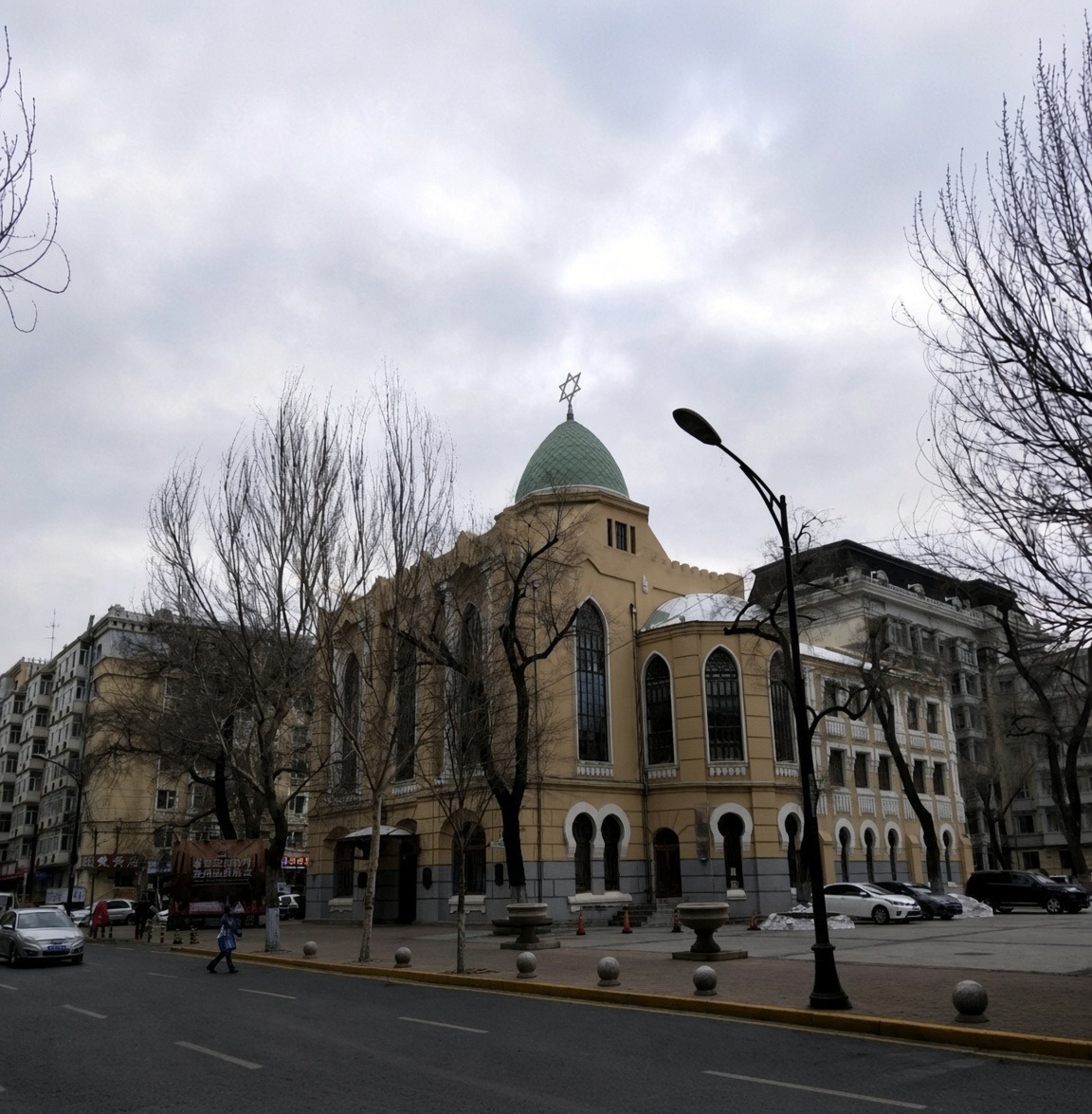
On this day, when I was twenty, it was raining too. I was sitting in Harbin’s Old Synagogue Concert Hall.
It was the most sparsely attended performance I had ever been to. Seven or eight people sat scattered about the little chapel; even with the performers, there would scarcely have been enough of us to form a modest string ensemble. Our host was a slightly stout, middle-aged clarinettist, who introduced the two works on the programme in a pronounced Taiwanese accent. The pianist beside him—his newly married wife—left a particularly vivid impression on me. She had the round, fair face of a girl from China’s Northeast, and sat quietly at the piano. Whenever her husband introduced her, she would turn an elegant smile towards us, her expression always gentle and composed, as though she were the true mistress of the hall. Perhaps she embodied the kind of woman who had always enchanted me. At the time, I longed for love, yet already felt that the love I wanted was not one I would ever find.
I can no longer remember which work by Schumann they played. But Brahms’s Op. 114, which followed the interval, shook me profoundly. From the very first bar of the first movement, the cello rose, the piano murmured, and the clarinet came after them. Then, as though a hand had suddenly let go, the strings plunged; as they came to rest, the clarinet’s voice lingered, incomparably beautiful. The second movement seemed a remembrance of years long past: the clarinet tender and ardent, the cello interjecting its bewilderment, the piano’s pearled notes like light trembling on the river of memory. Gratitude and uncertainty sang softly through one another, and for a moment all three instruments seemed to have come alive. Each of the four movements was exquisitely wrought. The first three felt so much of a piece that the musicians scarcely paused between them. In the glances they exchanged, you could sense their extraordinary affection for the work. This late nineteenth-century clarinet trio is one of the less familiar works among the chamber pieces in which the ageing Brahms reached the summit of his art. He could hardly have imagined that, on a summer’s day more than two hundred years later, this perfectly formed work would sound in an unassuming little hall in a distant city, awakening the instruments that slumbered there.
That moment seemed to hold everything chamber music could mean: soft rain outside the windows, scarcely any listeners, dim and quiet light, the clarinet’s voice old and delicate. I had never heard music of such harmony and depth—not even in the Mozart I loved so much then. Mozart’s harmony and vitality were plain to see; Brahms’s lay hidden in the marrow. At first hearing, his music could seem strange, the purpose of his notes obscure. But once you came to know its bones and wander among them, affection became inescapable: affection for that singular obstinacy, for a temperament at once weighty and innocent, austere and romantic, without the least contradiction. At twenty, I began to believe that the most beautiful things might also be hidden, unknown to the world. All you could hope was to meet one of them someday, at some inconspicuous street corner, and quietly lift its veil—to find your soul shaken.
Today, five years later, in my second year of theoretical physics, I suddenly understand that day more deeply. I miss the graceful pianist and the middle-aged man who played the clarinet. There had been something a little unusual in his voice as he introduced the music: tentative, perhaps, or gently self-mocking. The nearly empty hall and the blank faces before him must have made him uneasy. Brahms’s Op. 114? He probably knew what to expect, yet the reality must have been bleaker still. Most of the seven or eight listeners were pensioners with time on their hands, or children taking music lessons nearby. Halfway through the performance, even the child who had answered him so eagerly at the beginning left with his mother. He was not a celebrated musician. He and his wife, a native of Harbin, had only recently made their home in this little concert hall in the northern city of ice. But how many people here loved the clarinet? How many loved Brahms? I very much wanted to tell him that both his playing and his introduction had been wonderful—that, to me at least, they had mattered. Yet I walked out of the chapel without finding the courage to say those slightly embarrassing words.
I understand now that those words were never meant for him alone. On entering the academic world, I found myself deeply disheartened by its endless fashionable but meaningless research topics and measures of achievement. Gradually, I came to see that music, painting, and my own discipline of theoretical physics all carry, beneath their professional techniques, something intangible: taste. Taste in beauty, taste in thought. It cannot be acquired by following a fashion; it is difficult to cultivate, and I know of no scale by which to measure it. It rests on intuition, instinct, and gifts that only a few are destined to possess. In modern society, then, fields that ought to give equal weight to vision and craft are inevitably drawn into an industrial hierarchy governed by technique, producing many first-rate practitioners who remain, in art or scholarship, merely skilled technicians. Good taste does not always receive the resources or recognition it deserves. More than once I have come to understand Chen Danqing’s remark: “The public does not understand art; it merely worships things that are famous.” Nor, I think, does the public understand truth. It trusts only voices that come with titles.
Part of what I miss about that concert may also be a certain precious innocence. I did not yet know Brahms, or where the enchantment of chamber music lay. That moment was like a casket opening onto a new universe; my heart was full of wonder and anticipation. It was the same feeling I had when I first encountered the information paradox last year. Yet as I approach my twenty-fifth year, I know that my sense of taste is growing less keen. How many things remain that can stir the heart and draw the desire to know after them? Sometimes I begin to worry. The end of youth has little to do with age. Whenever wonder vanishes, something of our youth dies forever.
When the performance ended that day, I opened my umbrella, yet felt as though I had already been drenched. Recalling the four movements in the rain, I found myself thinking of the lines, “Looking back towards the place of wind and desolation”—and, “Neither storm nor clear sky now.” In his old age, Brahms had indeed been captivated once more by the beauty of the clarinet’s voice and had set to work composing for it with scarcely a pause. Op. 120 and Op. 115 are among the treasures of those years. In them, you hear no lament for age or fading powers. Instead there is purity, and wonder—neither lost even as death draws near. Though his lifelong love never came to fruition, his youth, in truth, never died.